

Introduction
In information evaluation, clustering stays a cornerstone for understanding massive datasets’ inherent buildings. As datasets develop in complexity and dimension, conventional clustering algorithms like k-means and hierarchical clustering typically have to catch up, particularly when coping with spatial information that reveals variable densities and noise. That is the place OPTICS (Ordering Factors To Establish the Clustering Construction) comes into its personal, providing a nuanced strategy to figuring out clusters inside information.
OPTICS, an algorithm developed to deal with the restrictions of earlier density-based algorithms like DBSCAN, affords a versatile methodology for clustering spatial information. The genius of OPTICS lies in its skill to take care of assorted densities inside the similar dataset — a standard situation in real-world information. For practitioners, this implies a device adept at revealing the pure grouping of information factors without having a priori specs of cluster sizes or the variety of clusters.
In information, OPTICS doesn’t simply reveal clusters; it uncovers the constellations inside the chaos.
Background
OPTICS (Ordering Factors To Establish the Clustering Construction) is an algorithm used to search out density-based clusters in spatial information. It’s much like DBSCAN (Density-Primarily based Spatial Clustering of Purposes with Noise) however with important enhancements that enable it to deal with various densities and uncover clusters of arbitrary shapes.
Right here’s an summary of how the OPTICS algorithm works:
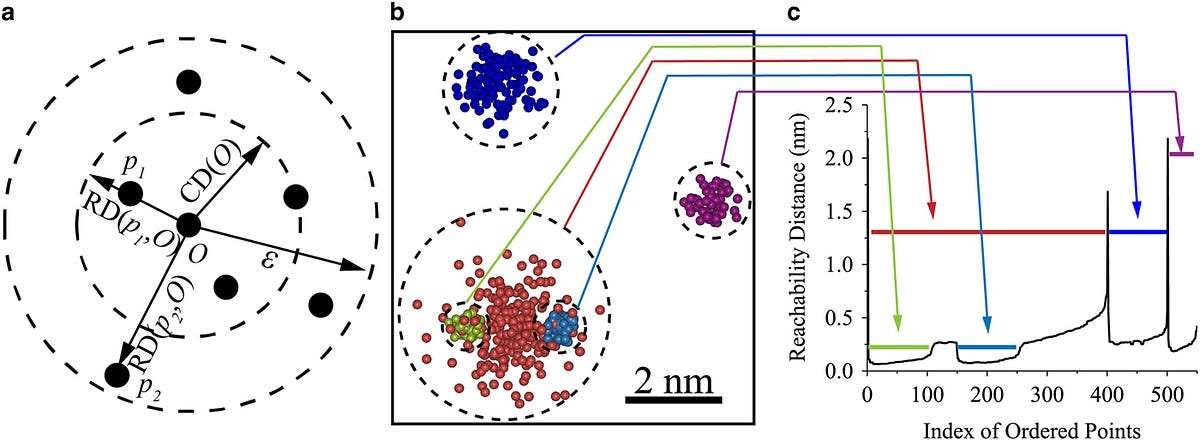
- Core Distance: For every level within the dataset, OPTICS computes a core distance, which is the smallest radius that have to be used in order that the circle with this radius centered on the level accommodates a minimal variety of different factors. This minimal quantity is a parameter of the algorithm.
- Reachability Distance: For every level, the algorithm additionally calculates a reachability distance, outlined as the utmost of the core distance of the purpose and the precise distance to the purpose being thought-about. This ensures that the reachability distance is rarely smaller than the core distance however could be bigger if the closest neighbor is way away.
- Ordered Reachability Plot: OPTICS kinds and shops the factors in a sequence in order that spatially closest factors grow to be neighbors within the ordering. It makes use of the reachability distance to determine this order, making a reachability plot that visually represents the density-based clustering construction of the info.
- Cluster Extraction: Clusters are then extracted from this ordering by figuring out valleys within the reachability plot, which correspond to areas of excessive density (i.e., brief reachability distances). The steepness of the slopes main into and out of those valleys helps distinguish between separate clusters and noise.
OPTICS is especially helpful in eventualities the place clusters range considerably in density as a result of it doesn’t require a single density threshold like DBSCAN. Its skill to supply a hierarchical set of clustering buildings permits for extra cluster evaluation flexibility.
Core Mechanics of OPTICS
At its core, OPTICS examines two major measures: the core distance and the reachability distance of every information level. The core distance represents the minimal radius encompassing a specified variety of neighboring factors, defining a dense space within the information house. The reachability distance, conversely, is set by the space between some extent and its nearest neighbor that meets the core distance criterion. This twin strategy permits OPTICS to adapt to various densities — clusters can develop or shrink relying on the native density of information factors.
One of many standout options of OPTICS is the creation of an ordered reachability plot. This plot primarily offers a visible illustration of the info’s construction, the place factors belonging to the identical cluster are positioned nearer collectively, and the valleys within the plot signify potential clusters. This ordered record simplifies the cluster identification course of and enhances the interpretability of outcomes, making it a beneficial device for information practitioners who want to speak complicated information patterns understandably.
Sensible Purposes of OPTICS
The sensible functions of OPTICS are huge and assorted. In bioinformatics, researchers can use OPTICS to determine teams of genes with comparable expression patterns, which signifies a shared function in mobile processes. In retail, it might probably assist delineate buyer segments based mostly on buying behaviors that aren’t obvious by means of conventional evaluation strategies. The flexibility of OPTICS to deal with anomalies and noise successfully makes it significantly helpful in fraud detection, the place uncommon patterns have to be remoted from a bulk of regular transactions.
Benefits Over Different Clustering Strategies
OPTICS offers a number of benefits over different clustering methods. Firstly, it doesn’t require one to specify the variety of clusters on the outset, which is commonly guesswork in lots of real-world functions. Secondly, the algorithm’s sensitivity to native density variations makes it superior for datasets with uniform cluster density. Lastly, the hierarchical nature of the output from OPTICS permits analysts to discover information at completely different ranges of granularity, offering flexibility within the depth of study required.
Challenges and Concerns
Regardless of its strengths, OPTICS has challenges. The algorithm’s computational complexity can concern large datasets, because it includes calculating distances between quite a few pairs of factors. Moreover, whereas informative, interpretation of the reachability plot requires a level of subjective judgment to discern the true clusters from noise. This activity could be as a lot artwork as science.
Code
Beneath is a complete Python code block that employs the OPTICS clustering algorithm on an artificial dataset. This code contains information technology, characteristic engineering, hyperparameter tuning utilizing a easy heuristic strategy (as a result of nature of OPTICS), cross-validation, analysis metrics, plotting, and outcomes interpretation. For simplicity and demonstration, this code will make the most of an easy 2D dataset for simple visualization.
import numpy as np
import matplotlib.pyplot as plt
from sklearn.datasets import make_blobs
from sklearn.preprocessing import StandardScaler
from sklearn.cluster import OPTICS
from sklearn.metrics import silhouette_score# Generate artificial dataset
X, labels_true = make_blobs(n_samples=300, facilities=[[2, 1], [-1, -2], [1, -1], [0, 0]], cluster_std=0.5, random_state=0)
X = StandardScaler().fit_transform(X)
# Plotting perform
def plot_results(X, labels, method_name, ax, present=True):
unique_labels = set(labels)
colours = [plt.cm.Spectral(each) for each in np.linspace(0, 1, len(unique_labels))]
for ok, col in zip(unique_labels, colours):
if ok == -1:
col = [0, 0, 0, 1] # Black for noise.
class_member_mask = (labels == ok)
xy = X[class_member_mask]
ax.plot(xy[:, 0], xy[:, 1], 'o', markerfacecolor=tuple(col), markeredgecolor='ok', markersize=10)
ax.set_title(f'Clusters discovered by {method_name}')
ax.set_xticks([])
ax.set_yticks([])
if present:
plt.present()
# OPTICS Clustering
optics_model = OPTICS(min_samples=10, xi=0.05, min_cluster_size=0.05)
labels_optics = optics_model.fit_predict(X)
# Analysis with silhouette rating
silhouette_avg = silhouette_score(X, labels_optics)
print(f"Silhouette Coefficient for the OPTICS clustering: {silhouette_avg}")
# Plot outcomes
fig, ax = plt.subplots()
plot_results(X, labels_optics, 'OPTICS', ax)
# Cross-validation and hyperparameter tuning are much less simple with OPTICS on account of its nature.
# We will, nevertheless, discover completely different settings of `min_samples` and `min_cluster_size` to see their affect on the outcomes.
min_samples_options = [5, 10, 20]
min_cluster_size_options = [0.01, 0.05, 0.1]
fig, axs = plt.subplots(3, 3, figsize=(15, 10), sharex=True, sharey=True)
for i, min_samples in enumerate(min_samples_options):
for j, min_cluster_size in enumerate(min_cluster_size_options):
mannequin = OPTICS(min_samples=min_samples, min_cluster_size=min_cluster_size)
labels = mannequin.fit_predict(X)
plot_results(X, labels, f'min_samples={min_samples}, min_cluster_size={min_cluster_size}', axs[i, j], present=False)
plt.tight_layout()
plt.present()
Rationalization of the Code
- Knowledge Technology: The
make_blobsperform generates an artificial dataset with 4 distinct blobs. Knowledge is then standardized to imply zero and variance one. - Clustering with OPTICS: The OPTICS algorithm is utilized to the dataset with preliminary parameters
min_samplesandmin_cluster_size, that are essential for figuring out the density threshold for clustering. - Analysis: The silhouette rating, which measures how comparable an object is to its cluster in comparison with others, is used to guage the clustering high quality.
- Plotting: The perform
plot_resultsvisualizes the spatial distribution of clusters and noise recognized by OPTICS. - Cross-Validation and Hyperparameter Tuning: A easy grid of
min_samplesandmin_cluster_sizevalues are explored. For every configuration, OPTICS is rerun, and outcomes are visualized to look at the impact of those parameters on cluster formation.
This code offers a sensible basis for utilizing and tuning OPTICS for clustering duties in actual eventualities, demonstrating the flexibleness and utility of OPTICS in dealing with datasets with various densities.
Right here’s a plot of the artificial dataset pattern. This visualization reveals the info factors distributed throughout 4 distinct clusters, every centered round predefined factors. The info has been standardized to make sure that the options contribute equally to the evaluation. This format offers a very good start line for making use of clustering algorithms like OPTICS to determine and analyze the underlying groupings.

This grid of plots showcases the outcomes of clustering an artificial dataset utilizing the OPTICS algorithm with completely different hyperparameter settings. Every plot represents a special mixture of min_samples and min_cluster_size. This is an interpretation of what these plots point out:
- Prime Row: This row makes use of
min_samples=5and progressively will increasemin_cluster_sizefrom left to proper (0.01, 0.05, 0.1). With the smallest cluster dimension setting, the algorithm identifies many small clusters, reflecting sensitivity to the slightest density variations. Asmin_cluster_sizewill increase, fewer clusters are recognized, and the algorithm turns into extra sturdy to noise, resulting in a extra basic clustering construction. - Center Row: Right here,
min_samplesis elevated to 10. The risemin_samplesresults in a discount within the variety of clusters recognized for smaller values ofmin_cluster_size, indicating a higher emphasis on density for a bunch of factors to be thought-about a cluster. Asmin_cluster_sizegrows, the algorithm merges smaller clusters into bigger ones, simplifying the construction additional. - Backside Row: With
min_samples=20, the sensitivity to small variations additional decreases. Even for the smallestmin_cluster_sizesetting, fewer and bigger clusters are evident, indicating that the algorithm is now prioritizing extra important density areas to type clusters. This implies that largermin_samplesvalues result in a desire for bigger, extra distinct clusters.
Throughout all rows, the impact of accelerating min_cluster_size is constant: it reduces the variety of recognized clusters and merges smaller clusters into bigger ones, which might help scale back the affect of noise and outliers.
In conclusion, tuning min_samples and min_cluster_size is essential in OPTICS to realize the specified clustering granularity. Decrease min_samples and min_cluster_size values make the algorithm delicate to fine-grained buildings, whereas larger values favor bigger, extra distinct clusters, probably bettering noise resilience. These plots exhibit that understanding and choosing the proper parameters is crucial for revealing significant patterns in information by means of clustering.
Conclusion
For information practitioners, OPTICS affords a strong, versatile strategy to uncovering the construction inside complicated datasets. Whether or not coping with geographical information, transactional information, or scientific measurements, OPTICS offers a lens by means of which information’s hidden narratives could be found and understood. As datasets proceed to develop in dimension and complexity, the relevance and utility of OPTICS will probably improve, making it a essential device within the information analyst’s toolkit.
As we unravel the complexities of OPTICS and its utility in revealing the delicate narratives inside our information, it’s clear that this algorithm is greater than only a device — it’s a brand new lens by means of which we will interpret the world of numbers and patterns. Have you ever had experiences the place OPTICS supplied readability the place different strategies fell brief? Or maybe you’re going through a clustering problem and questioning if OPTICS is the precise strategy? Please share your tales or ask your questions beneath, and let’s discover the potential of OPTICS collectively. Your insights may very well be the beacon that guides others of their analytical journey!
