

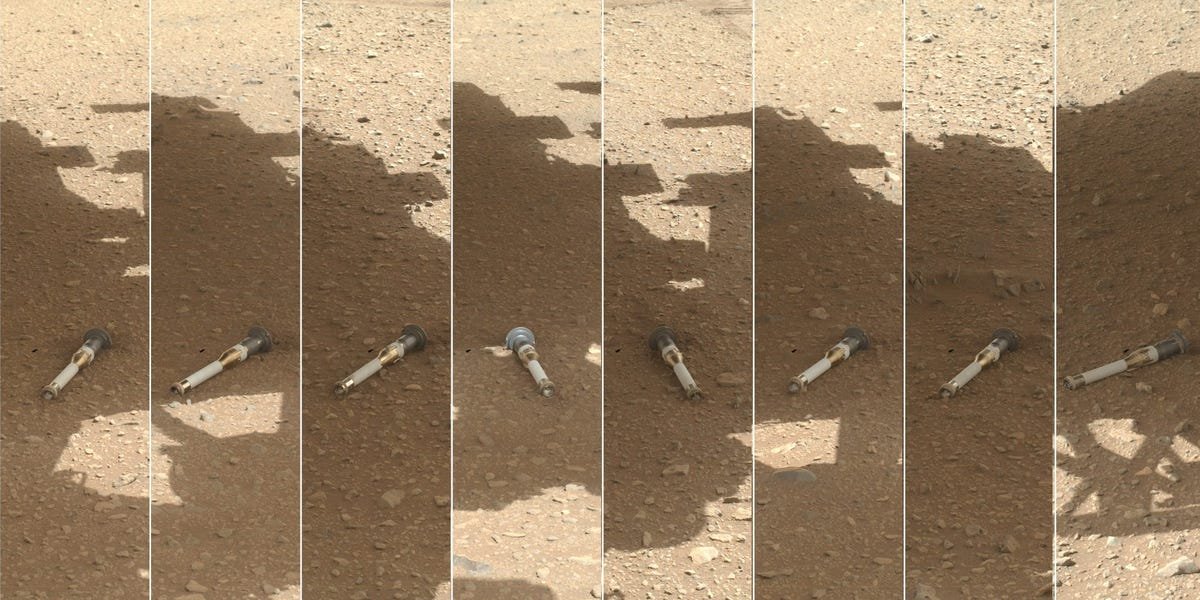
The $2.4 billion mission landed the rover in Jezero Crater, the location of an historical lake. It is the perfect spot to seek for the fossils of Martian microbes that will have existed when the planet was lush with lakes and rivers.
Perseverance’s major mission is to collect samples of the rock and sediment alongside the lake mattress and the crater rim, in hopes of discovering an indication that life as soon as thrived on the purple planet. The rover has completed a superb job — up to now it is secured 24 samples — however NASA not is aware of how it is going to carry them to Earth for evaluation.
NASA/JPL-Caltech/MSSS
NASA’s unique design for the retrieval mission, known as Mars Pattern Return, has fallen aside. The company is asking companies to step in and suggest higher concepts.
“We’re out-of-the-box potentialities that might return the samples earlier and at a decrease price,” Nicola Fox, head of NASA’s Science Mission Directorate, mentioned in a press briefing on Monday. “That is undoubtedly a really bold purpose. We will must go after some very progressive new potentialities for design, and definitely depart no stone unturned.”
NASA’s previous plan prices $11 billion and takes too lengthy
NASA’s unique proposal for the Mars Pattern Return is “mind-bendingly difficult,” David Parker, director of area exploration on the European House Company, mentioned in 2021.
The concept was to launch two rockets towards Mars, one carrying a lander and one carrying an orbiter.
The lander can be the biggest ever despatched to Mars. It could contact down close to the stash of samples that Perseverance arrange, deploy a rover to fetch the pattern tubes, and cargo them onto a small rocket hooked up to the lander.
Then the rocket would launch the samples into Mars orbit, the place it might eject them towards the orbiter, which might be the biggest spacecraft NASA ever despatched to Mars.
The orbiter must seize the samples, journey back to Earth, and drop the pattern vessel on a fiery plummet to our planet’s floor, the place a staff would retrieve them.
The mission plan relied about $4 billion in new know-how and a decade of mission design and building.
However the projected price has ballooned to $8 to $11 billion since Perseverance touched down at Jezero Crater. Impartial critiques have additionally concluded that as an alternative of 1 decade to carry the samples to Earth, it might take two.
“The underside line is that $11 billion is just too costly, and never returning samples till 2040 is unacceptably too lengthy,” NASA Administrator Invoice Nelson mentioned within the briefing. “It is the last decade of the 2040s that we will be touchdown astronauts on Mars.”
On the present price ticket, Mars Pattern Return would “cannibalize” different NASA missions, Nelson mentioned. So the company is looking all palms on deck, inside and outdoors of NASA, to provide you with a brand new plan.
NASA desires firms with ‘tried-and-true’ know-how
Fox mentioned that NASA must see brief proposals from firms or laboratories by Could 17. Then the company will select a number of of these opponents to additional develop their concepts over a 90-day interval, with full proposals on NASA’s desk by late fall or early winter.
A few of NASA’s most tried-and-true contractors embrace Lockheed Martin, Northrop Grumman, Boeing, and SpaceX. Startups like Astrobotic and Intuitive Machines are getting their foot within the NASA door by the company’s new moon program.
“What we’re hoping is that we will get again to some extra conventional tried-and-true architectures,” Fox mentioned. “Something requiring enormous leaps in know-how often, from expertise, takes quite a lot of time.”
As for the return journey from Mars to Earth, that can be a technological leap it doesn’t matter what.
“We have by no means launched from one other planet, and that is really what makes Mars Pattern Return such a difficult and attention-grabbing mission as a result of it truly is the primary of a sort,” Fox mentioned.
