

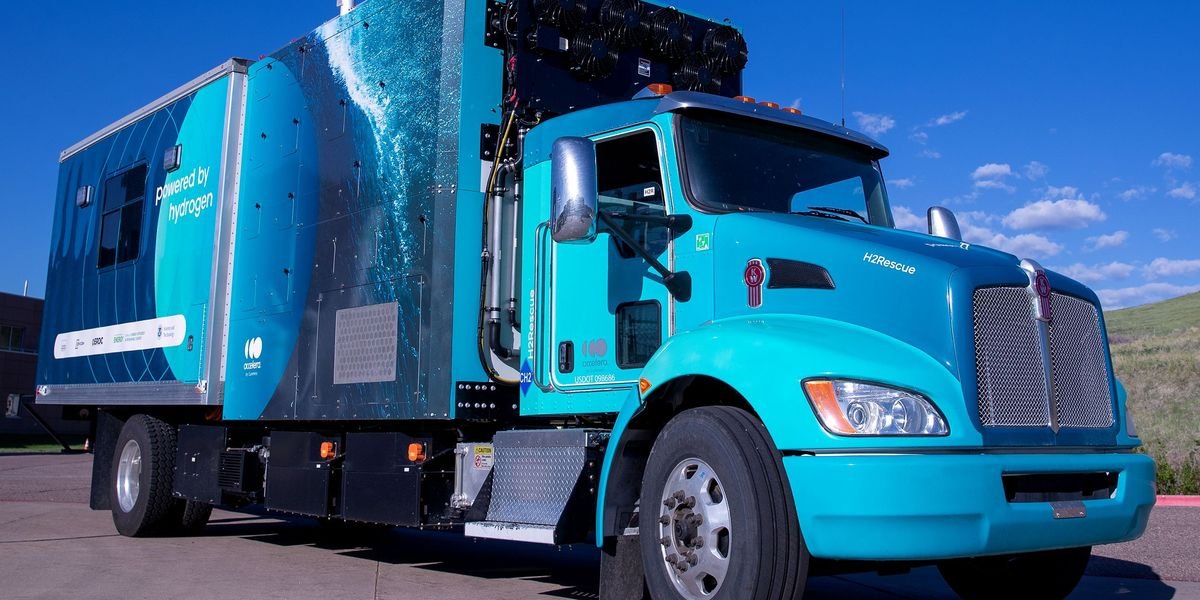
A consortium of U.S. federal businesses has pooled their funds and big range of experience to reinvent the emergency car. The hybrid electrical field truck they’ve give you is carbon impartial. And within the aftermath of a pure catastrophe like a twister or wildfire, the car, referred to as H2Rescue, can provide electrical energy and potable water to survivors whereas performing as a temperature-controlled command heart for rescue personnel.
The businesses that funded and developed it from an thought on paper to a practical Class 7 emergency vehicle prototype say they’re happy with the result of the venture, which is now getting used for additional analysis and improvement.
“Any time the gas cell is producing vitality to maneuver the car or to export energy, it’s producing water.” –Nicholas Josefik, U.S. Military Corps of Engineers Building Analysis Lab
Industrial truck and locomotive engine maker Cummins, which has pledged to make all its heavy-duty highway and rail autos zero-emission by 2050, gained a $1 million aggressive award to construct the H2Rescue, which will get its energy from a hydrogen gas cell that expenses its lithium-ion batteries. In demonstrations, together with one final summer season at National Renewable Energy Lab services in Colorado, the truck proved able to driving 290-kilometers, then taking over the roles of energy plant, cell command heart, and (courtesy of the truck’s “exhaust”) provider of fresh consuming water.
A hydrogen tank system situated behind the 15,000-kilogram truck’s cab holds 175 kg of gas at 70 megapascals (700 bars) of strain. Civilian anthropology researcher Lance Larkin on the U.S. Army Corps of Engineers’ Construction Engineering Research Laboratory (CERL) in Champaign, In poor health., informed IEEE Spectrum that that’s sufficient gas for the gas cell to generate 1,800 kilowatt-hours of vitality. Or sufficient, he says, to maintain the lights on in 15 to twenty common U.S. properties for about three days.
The gas cell can present vitality on to the truck’s powertrain. Nonetheless, it primarily expenses two battery packs with a complete capability of 155-kilowatt-hours as a result of batteries are higher than gas cells at dealing with the variable energy calls for that include car propulsion. When the truck is at a catastrophe website, the gas cell can routinely flip itself on and off to maintain the batteries charged up whereas they’re exporting electrical energy to buildings that may in any other case be at nighttime. “If it’s referred to as upon to export, say, 3 kilowatts to maintain a number of computer systems working, the gas in its tanks may preserve them powered for weeks,” says Nicholas Josefik, an industrial engineer at CERL.
As if that weren’t sufficient, an onboard storage tank captures the water that’s the byproduct of the electrochemical reactions within the gas cell. “Any time the gas cell is producing vitality to maneuver the car or to export energy, it’s producing water,” says Josefik. The end result: roughly 1,500 liters of fresh water accessible anyplace the place municipal or properly water provides are unavailable or unsafe.
“When the H2Rescue drives to a location, you gained’t want to drag that generator behind you, as a result of the truck itself is a generator.” —Nicholas Josefik, U.S. Military Corps of Engineers Building Analysis Lab
Simply as vital as what it might probably do, Josefik notes, is what it gained’t do: “In a standard emergency scenario, you ship in a diesel truck and that diesel truck is pulling a diesel-powered generator, so you possibly can present energy to the positioning,” he says. “And one other diesel truck is pulling in a gas tank to gas that diesel generator. A 3rd truck would possibly pull a trailer with a water tank on it.
“However when the H2Rescue drives to a location,” he continues, “You gained’t want to drag that generator behind you, as a result of the truck itself is a generator. You don’t have to pull a trailer filled with water, as a result of you realize that when you’re on website, H2Rescue shall be your water supply.” He provides that H2Rescue is not going to solely permit first responders to eradicate a number of items of kit however can even eradicate the air air pollution and noise that come normal with diesel-powered autos and turbines.
Larkin recollects that the impetus for creating the zero-emission emergency car got here in 2019, when a series of natural disasters across the United States, including wildfires and hurricanes, spurred motion. “The organizations that funded this venture had been observing this and noticed a necessity for another emergency help,” he says. They requested themselves, Larkin notes, “‘What can we do to assist our first responders tackle these pure disasters?’ The remainder, as they are saying, is historical past.”
Requested once we’ll see the Federal Emergency Management Agency, which is usually in control of catastrophe response wherever within the 50 U.S. states, dispatch the H2Rescue truck to the aftermath of, say, a hurricane, Josefik says, “That is nonetheless a analysis unit. We’re engaged on attempting to construct a model 2.0 that might go and help responders to an emergency.” That subsequent model, he says, can be the results of some optimizations urged by Cummins because it was placing the H2Rescue collectively. “As a result of this was a one-off construct, [Cummins] recognized a lot of areas for enchancment, like how they’d do the wiring and the piping in a different way, so it’s extra compact within the unit.” The purpose for the second iteration, Larkin says, is “a turnkey unit, able to function with out all the additional gauges and monitoring tools that you just wouldn’t need in a car that you’d flip over to someone.”
There is no such thing as a timetable for when the brand new and improved H2Rescue will go into manufacturing. The businesses that allotted the funds for the prototype haven’t but put up the cash to create its successor.
From Your Website Articles
Associated Articles Across the Net
